The Bitaxe Ultra is a relatively new entrant in the world of compact/“micro” Bitcoin miners. It’s part of the “lottery miner” category: small-scale miners with relatively low hashrate, that attempt solo mining. Because solo mining is very “hit-or-miss,” these devices are often described metaphorically as “lottery tickets” — you rarely win (find a block), but the payoff is big if you do.
Key features:
-
It uses a BM1366 ASIC chip (the same chip family used in Bitmain’s Antminer S19XP) for the mining work. xon
-
Hashrate is usually in the ballpark of ~500 GH/s (sometimes 500-550 GH/s), though claims vary.
-
Power consumption tends to be low compared to full-scale miners (e.g. around 10-20 W depending on settings) which gives decent energy efficiency for its scale.
-
It supports WiFi, and is designed to work standalone. No need for a full ASIC rig or server; the idea is that it’s plug-and-play.
-
It’s open-source: the hardware and firmware design files are publicly available. That also means there’s a community that modifies / tunes the device.
What “Lottery Miner” / “Solo Mining” Means in This Context
To understand what you’re getting with something like the Bitaxe Ultra, it helps to know what solo or lottery mining is:
-
Bitcoin blocks are awarded to whoever solves a cryptographic puzzle first. The chance to solve a block is proportional to your hashrate vs the total network hashrate. With a very small hashrate, the odds are extremely low.
-
Lottery miner devices accept that reality: most of the time you earn nothing, but occasionally (if very lucky) you might find a block and claim the full block reward (minus fees). That’s what people mean by describing them as lottery tickets.
-
Because the device consumes power, you still have operating costs. So the economics depend heavily on electricity cost, uptime, how “luck” plays out, and firmware/hardware efficiency.
Technical & Economic Performance
Here are some of the reported technical details and economic estimates, along with caveats:
| Spec / Claim | Reported Value | Notes & Caveats |
|---|---|---|
| Hashrate | ~500-550 GH/s typical; possibly up to ~600 GH/s under certain conditions or overclocking. | |
| Power Draw | Usually around 10-20 Watts depending on frequency/voltage settings. | |
| Efficiency | Judged relatively good for small scale; because there's only one ASIC chip, and low overhead. | |
| Cost | Prices vary quite a lot; some places list it around USD $100-200 (or equivalent), depending on whether it’s just the board, includes power supply, case/display etc. | |
| Payoff Chances | Some sellers estimate the chance of finding a block as something like 1 in ~265,000 per month at that hashrate. But those are probabilistic estimates, not guarantees. |
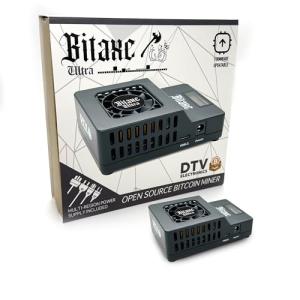
Bitaxe Open Source Bitcoin ASIC Miner - 500 GH/s
Get powerful mining performance with this easy-to-use open source Bitcoin ASIC miner
Product information
$94.99 $89.99
Product Review Score
4.48 out of 5 stars
185 reviews